Take the Guesswork Out of Your Next Board
Whether you are ordering a custom shape from your local shaper or hunting for a used board on Facebook Marketplace, getting your volume right is the single most important factor in your surfing progression.
Our interactive surfboard volume calculator features a live visual blueprint and advanced shape multipliers, allowing you to instantly estimate the exact liters of your next board. No more guessing. No more struggling to paddle into waves.
How to Use This Surfboard Volume Calculator

We built this tool to be the most accurate and visual volume estimator on the web. It features two distinct modes:
1. The Custom Volume Calculator (With Live Blueprint)
If you are tweaking dimensions for a custom shape, use our interactive sliders.
Select Your Shape: Choose from Pro Shortboard, Daily Driver, Retro Fish, Mid/Groveler, Step-Up/Gun, or Longboard. Each shape has a unique foam distribution multiplier built into our algorithm.
Adjust Dimensions: Drag the length, width, and thickness sliders.
Live Blueprint: Watch the CAD-style blueprint stretch and morph in real-time to match your exact dimensions. Your estimated volume in liters (L) will calculate instantly.
2. The Stock Board Lookup
Want to know the exact volume of a factory board? Switch to the Stock Lookup tab. Simply select the brand (e.g., Pyzel, Lost, Channel Islands), pick the model, and select the length. The tool will output the verified factory liters and dimensions.
Why Surfboard Volume Matters
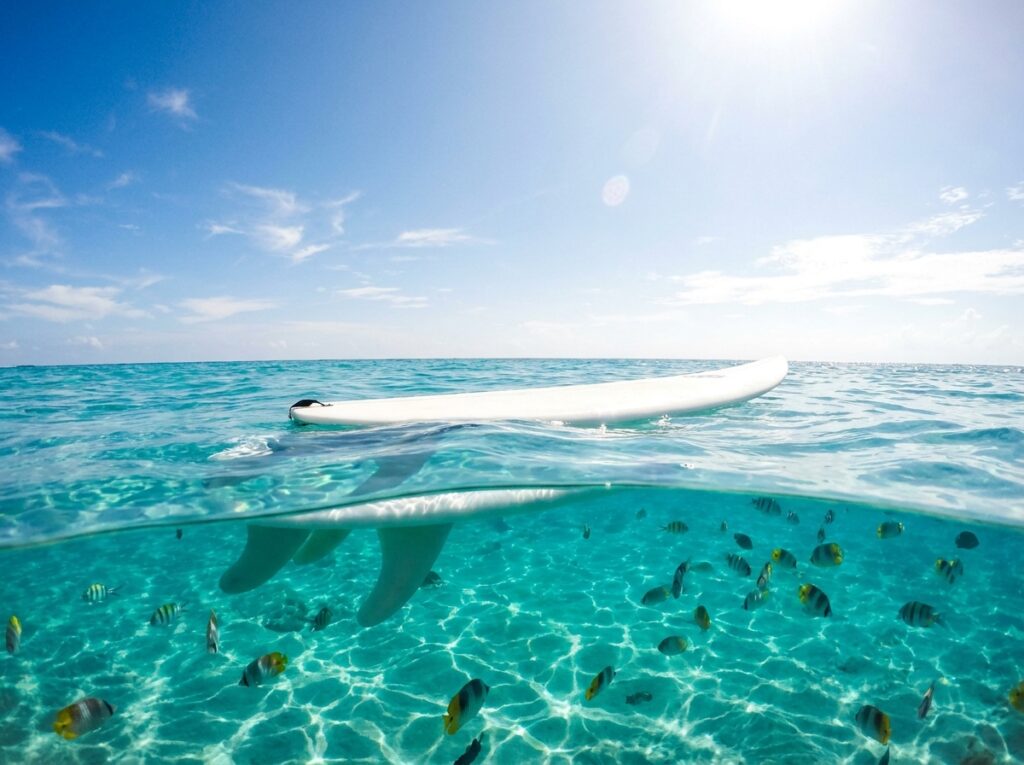
Surfboard volume (measured in liters) dictates how buoyant a board is in the water. It directly impacts every aspect of your session:
Paddling Power & Catching Waves: More volume equals more buoyancy. You will sit higher in the water, glide through the lineup faster, and catch waves with far less effort.
Maneuverability: Less volume means the board sits lower in the water. This allows the rail to bite into the wave face, making it much easier to turn sharply, sink the tail, and perform advanced maneuvers.
Duck Diving: If your board has too much volume for your weight, you will not be able to push it under the water to duck dive oncoming waves.
The secret to a magic surfboard is finding the perfect “Goldilocks” volume—enough foam to catch waves easily, but not so much that the board feels like a boat. For a deeper dive into how foam distribution changes your ride, check out our full guide on why you should know your surfboard volume.
The Physics of Volume: Displacement and Rocker
While volume tells you how much foam is in the board, where that foam sits—and how the board curves—completely changes your ride. This is the physics of displacement.
Imagine two surfboards: a 30L retro fish and a 30L pro shortboard. The fish has a very flat “rocker” (the curve from the nose to the tail), meaning it sits flat on the water, displaces less water while paddling, and glides effortlessly over weak, mushy sections. The 30L pro shortboard, however, has a heavy “banana” rocker designed to fit into steep, hollow waves. Even though both boards technically have the exact same buoyancy in liters, the high-rocker shortboard pushes more water (increasing drag) and will paddle much slower than the fish. This is why you cannot rely on liters alone; the board’s shape and outline always dictate how that volume behaves in the water.
How Your Wetsuit Affects Your Volume
When calculating your ideal volume, you must factor in your local water temperature and the gear you wear. A surfer wearing a thick 5/4mm winter wetsuit, neoprene boots, and gloves adds significantly more physical weight and faces more paddling resistance than someone surfing in tropical boardshorts. To compensate for this extra drag and physical fatigue in cold water, you should add a “winter volume bump” of 1 to 2 extra liters to your standard board dimensions.
How to Choose the Right Volume for Your Skill Level
Your ideal volume isn’t just about your weight; it is heavily dictated by your surfing ability.
(Pro Tip: If you don’t know your target volume yet, use our Ideal Surfboard Volume Calculator to get a personalized recommendation based on your weight, age, and fitness level before tweaking dimensions below.)
Beginners (High Volume): If you are just learning to pop up and ride the whitewash, you need maximum stability and paddle speed. Look for boards between 45L and 70L (typically Longboards or large Midlengths).
Intermediates (Medium Volume): As you start catching green waves and trimming down the line, you can drop your volume to unlock maneuverability. Intermediates usually ride boards between 30L and 40L (Fishes, Grovelers, and Daily Drivers).
Advanced/Pros (Low Volume): High-level surfers prioritize rail-to-rail transitions and deep duck dives. They often ride the absolute minimum volume necessary to keep them afloat,
typically between 24L and 29L.Real-World Volume Case Studies
To see how these shape multipliers and volume estimates play out in the lineup, let’s look at two completely different surfer profiles using our calculator.
Case Study 1: The Weekend Warrior in Mushy Waves
The Surfer: 80kg (176 lbs) Intermediate.
The Conditions: Weak, mushy summer beach breaks.
The Strategy: Because the waves lack pushing power, this surfer needs a board that generates its own speed. A low-volume pro shortboard would sink and bog down, making the session miserable.
The Recommendation: A 38L to 40L Groveler or Retro Fish. Using our calculator, adjusting the sliders to a 5’10” x 21 1/2″ x 2 3/4″ Mid/Groveler shape hits this sweet spot perfectly. It offers maximum paddle power and water displacement, while remaining short enough to turn easily.
Case Study 2: The Advanced Charger in Hollow Waves
The Surfer: 65kg (143 lbs) Advanced/Pro.
The Conditions: Steep, fast, hollow reef breaks.
The Strategy: Maximum paddle power is less critical here than rail control and the ability to duck-dive deep under heavy, breaking sets. Too much volume will prevent the board’s rail from biting into the steep wave face during critical drops.
The Recommendation: A 24L to 25.5L Pro Shortboard. Using our calculator, dialing in a 5’8″ x 18 1/2″ x 2 1/4″ shortboard shape provides the exact minimal volume needed to knife into late drops, easily duck-dive, and stay locked into the barrel.
Frequently Asked Questions (FAQ)
What is a surfboard volume calculator? It is a mathematical tool that multiplies a board’s length, width, and thickness, and then applies a specific shape coefficient (a multiplier based on whether the board is a shortboard, fish, or longboard) to estimate its total volume in liters.
Should I ride more volume in small waves? Yes. In weak, mushy, or small waves, the water provides less push. Riding a board with higher volume (like a groveler or fish) helps generate your own speed and keeps you gliding over flat sections.
Q: Does this calculator work for JS Industries boards?
A: Yes — JS Industries is one of the brands in our Stock Board Lookup above. Select JS Industries, choose your model, and pick the length to get the factory-verified volume. If your specific JS model isn’t listed yet, use the Custom Calculator instead and match it to the closest shape profile.
Are liters the only dimension that matters? No. While volume is incredibly helpful, foam distribution matters just as much. A 30L shortboard with a pointy nose will surf completely differently than a 30L retro fish with a wide, flat nose. Always consider the outline and rocker of the board alongside the liters.
How accurate is the custom calculator? Our custom calculator uses sophisticated multipliers based on industry-standard CAD shaping software. While a local shaper can hide extra foam in the rails or foil, this tool provides a highly accurate estimate for standard surfboard profiles.
How is surfboard volume calculated? Surfboard volume is calculated by multiplying the board’s length, width, and thickness (usually converted into centimeters or inches) to find a cubic volume. However, because surfboards are not perfectly rectangular blocks, shapers apply a specific “shape multiplier” to the formula depending on how thick the rails are and how wide the nose and tail are. This gives the final estimated measurement in Liters.
Is it better to have more volume on a surfboard? For beginner and intermediate surfers, yes, it is almost always better to err on the side of more volume. Extra volume increases your paddle speed, making it easier to catch waves early and providing more stability when you pop up. Advanced surfers, however, want less volume so they can easily sink the rails for sharp turns and deep duck dives.
Does a 1-liter difference in a surfboard matter? For beginners on a 50L midlength, a 1-liter difference is entirely unnoticeable. However, for a professional surfer riding a hyper-sensitive 24L shortboard, a 1-liter difference will drastically change how the board paddles, how deep it sits in the water, and how easily it can be pushed under the lip during a duck dive.
What is the “Winter Volume Bump” for surfboards? When the water gets cold and you are forced to wear a thick 4/3mm or 5/4mm winter wetsuit with neoprene boots and gloves, you are adding significant physical weight and paddling resistance to your body. To compensate for this extra drag and physical fatigue, experienced cold-water surfers typically add 1 to 2 extra liters of volume to their winter surfboards.
How does my weight affect the volume I need? Your body weight is the primary factor in determining your baseline volume because it dictates your displacement in the water. A heavier surfer requires more foam to achieve the same level of buoyancy as a lighter surfer. However, your fitness level and surfing ability heavily modify this baseline weight calculation.